
There are parallels between science and law. Both lawyers and scientists need a strong body of evidence to put forth a convincing novel argument. To quote Elle Woods, “you need…a reason to believe your claim should have, like, evidentiary support.”

So what happened in the case of Andrew Wakefield? Almost 22 years ago to date, Wakefield’s study (now retracted) that linked the MMR (measles, mumps, and rubella) vaccine to autism was published in the The Lancet, a top peer-reviewed medical journal. The paper discussed a cohort of 12 children. The paper claims that the subjects were “referred to the department of paediatric gastroenterology.” However, when Brian Deer followed up with the families in the midst of the article’s discrediting, he uncovered that some sought out Wakefield’s study with the undisclosed goal of suing vaccine manufacturers. It turns out that Wakefield was being funneled money to prove that his previously noted bowel-brain syndrome was associated with vaccine product-liability. He was also promoting, and in the process of patenting, his own single-virus shots that would alleviate the purported concerns with the attenuated MMR vaccine. In his investigation, Deer also illuminates many falsities included as evidence for the claim including erroneous autism diagnoses and misreported onset of symptoms post-vaccination.
In short, Wakefield’s study did not constitute sound science. The cohort was small, self-referred, free of control groups, and almost all evidentiary support stemmed from contorted parental anecdotes. Researchers behind this paper did not even attempt to replicate their findings in another context or larger sample size. Although the original paper does not assert that an association between the MMR vaccine and autism was proven, it concludes in the final sentences: “In most cases, onset of symptoms was after measles, mumps, and rubella immunisation. Further investigations are needed to examine this syndrome and its possible relation to this vaccine.” Despite the unsound science, this sentence was enough to send vulnerable parents and the ever-eager media into a frenzy. Even with the claims debunked by numerous large scale studies (1, 2, 3) , Wakefield refuses to retract his research, unlike his original colleagues, and fuels anti-vaxxer groups around the world.
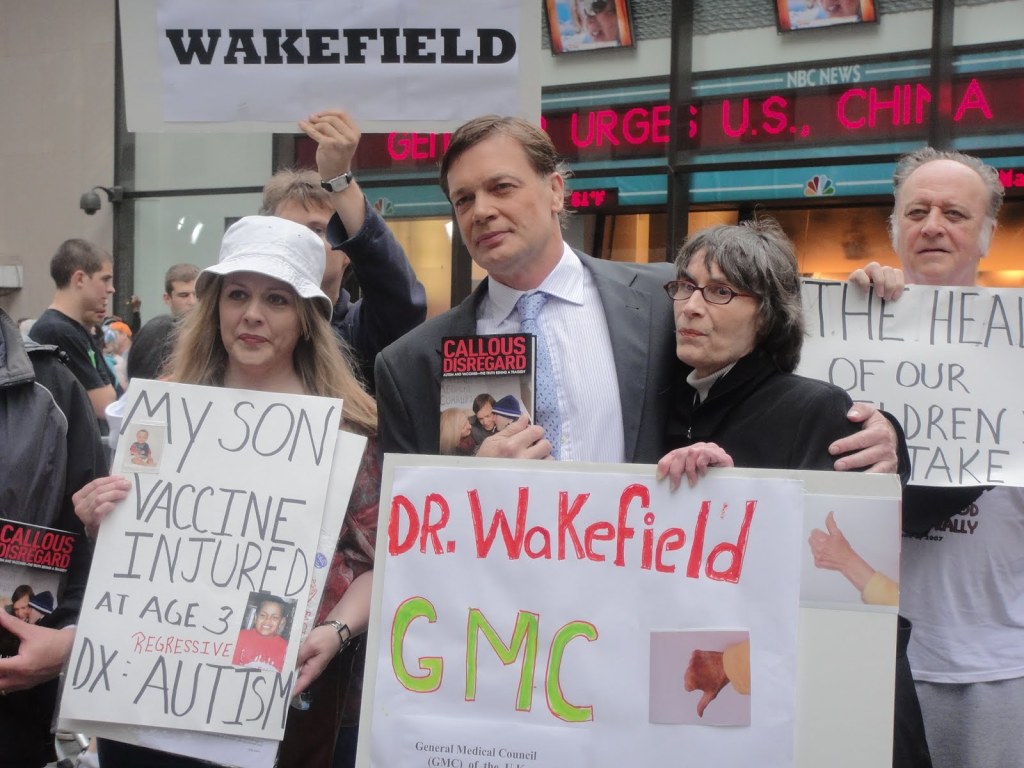
May 24, 2010
Vox news openly blames journalists for propelling undeserving scientific anomalies into the public eye. The ramifications of Wakefield’s biased case-study continue to play out in current time. Although the CDC reports for 2019 that 91.5%, and 91.0% of children aged 19-35 months in the U.S. received the MMR and varicella vaccines respectively, there are significant vaccination gaps in developing countries and select groups in the developed world. Unexpected outbreaks can therefore occur when a vaccinated traveler returns to the U.S and exposes a non-vaccinated group to the disease. U.S. outbreaks are small compared to the disease incidence that occurs in areas with large immunization gaps worldwide. The World Health Organization recently reported on the 2019 reemergence of measles in the Pacific. The governments of Samoa, Tonga, and Fiji conducted effective vaccination campaigns in response to the tragic loss of life in infants and young children. Sustained investments in public health efforts, with a focus on the poorest communities, are needed worldwide. The CDC lists their efforts in the matter here.
Educating people on the effectiveness and safeness of immunizations is one of the first steps in eradicating preventable disease. Andrew Wakefield and his faulty science set back the developed world. The majority of the U.S population cannot fathom the severity associated with the measles, mumps, rubella, and varicella-zoster (chickenpox) viruses. Letting these infectious agents weasel their way back into societies where they should no longer be present is a top public health concern. Do your research, find the evidentiary support, and follow the science.

 Layna's Microbiology Blog
[…] me.) In a previous post the advent of the anti-vaxxer mobilization was explored in the context of Andrew Wakefield’s “scientific” study. Despite his observations being dis-proven multiple times, the […]
LikeLike