

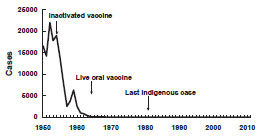
Poliomyelitis and polioencephalitis are infections caused by an enterovirus of the Picornaviridiae family presenting as a non-enveloped, icosahedral, single stranded, positive sense RNA virus. This detergent-resistant particle enters through the mouth via fecal-oral transmission (most-common) and inhalation of respiratory droplets (less-common). Once bound to the CD155 human cell receptor, the virus lives in the throat and intestines of infected individuals. Upon replication and viremia, the virus is able to target the nervous system and the anterior horns of spinal or brain stem grey matter causing paralysis or brain inflammation in many cases. Usual symptoms present in a 2-5 day period, but the virus sheds for up to two weeks in both the incubation and convalescent periods, adding to the virulence and historical rapid spread of this microbe in unsanitary and overcrowded areas. Between the late 1940s and early 1950s, polio crippled around 35,000 people in the U.S. alone, making it one of the most feared diseases of the 20th century. Because this virus only has a human reservoir, a vaccine was introduce in 1955, and only three wild serotypes are observed, it is the perfect candidate for vaccine induced eradication.

On Saturday, October 24th 2019, officials announced the worldwide eradication of wild poliovirus type 3 (WPV3), adding to the previous triumph of eliminating WPV2. The final step is to end the circulation WPV1 in Afghanistan and Pakistan and the resistant vaccine-derived polioviruses which have mutated beyond the constraints of the vaccine. Only when this mutant form circulates in an underimmunized population for 12-18 months is it occasionally able to reacquire neurovirulence from its original live attenuated form. This feat will require the intense commitment of these countries and their partners. Here, the progress towards polio eradication is vehemently tracked, including a summary of new viruses this week. To date in 2020, there have been 12 documented WPV1 cases all occurring in Pakistan.
There are two forms of the poliovirus vaccine: inactivated polio vaccine (IPV) and oral polio vaccine (OPV). IPV is the only vaccine given in the US since 2000, and the shot is recommended by the CDC in four doses throughout a child’s first 18 months. OPV is no longer licensed or available in the U.S. because of the risk associated in creating vaccine-derived polioviruses, but is frequently used in other countries because it can be easily given by volunteers. Because IPV is not a “live” vaccine, the contents do not replicate in the body and therefore are not able to spread and mutate. Additionally, it poses no threat to immunocompromised individuals. However, the vaccine confers low immunity in the intestines and asymptomatic infected people can spread wild-type virus. For this reason, IPV cannot be used in areas where outbreak control is urgent or immunity and sanitation are low. OPV contains attenuated polioviruses that actively replicate in the intestines, allowing a large protective immune response to surmount and interrupt person to person transmission. Additionally, the shedding of this attenuated form can passively spread immunity in a community where fecal-oral transmission frequently occurs due to poor hygiene and sanitation. The public reaction to polio today proves the immense success of these vaccines. Fear is not rampant and suffering significantly reduced. The demise of the last poliovirus is in sight.

 Layna's Microbiology Blog